 MamaBee
Wake Windows by Age: The Nap-Timing Cheat Sheet That Ends the Meltdowns

There's a very specific meltdown you can almost set your watch to — the one that arrives when a baby has been awake about ten minutes too long. For weeks I was sure it was hunger, or gas, or teething. It was none of those. It was the wake window.
Once I learned to time sleep by wake windows instead of the clock, our days got dramatically calmer. Here's the full wake windows by age cheat sheet, how to read your baby's sleepy cues, and how to use both to make naps easy.
What is a wake window?
A wake window is simply how long your baby can comfortably stay awake — feed, play, and all — before they need to sleep again. Time sleep near the end of the window and it comes easily. Miss it and you get an overtired baby who, cruelly, fights sleep *harder*.
Wake windows by age (the cheat sheet)
Use these as starting points, then adjust to your baby:
| Baby's age | Wake window | Naps per day |
|---|---|---|
| 0–1 month | 35–60 min | 6–8 (short) |
| 1–2 months | 45–90 min | 5–7 |
| 3–4 months | 75–120 min | 4–5 |
| 5–6 months | 2–2.5 hrs | 3 |
| 7–9 months | 2.5–3.5 hrs | 2–3 |
| 10–12 months | 3–4 hrs | 2 |
Note that the first wake window of the day is usually the shortest, and windows tend to stretch a little as the day goes on.
How to read sleepy cues
The clock gets you close; your baby's cues get you exact. Watch for:
- Early cues: yawning, staring off, slowing down, getting quiet
- Later cues: red or raised eyebrows, ear pulling, clenched fists, rubbing eyes
- Overtired (too late): frantic crying, arching, wired "second wind" energy
Aim to start winding down at the early cues, before the meltdown.
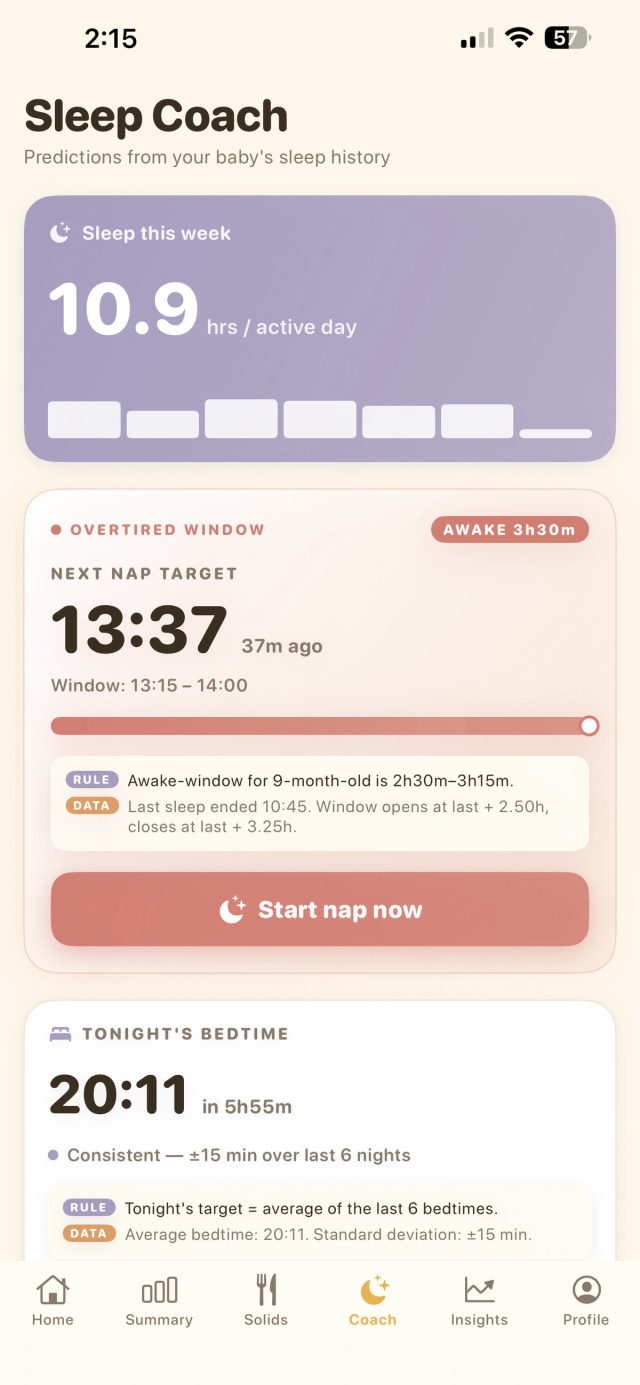
Let MamaBee predict the next nap from your baby's wake windows — so you can wind down before the meltdown, not after.
Get the appWhy nap timing fixes so much fussiness
The "witching hour" fussiness I kept trying to fix with extra feeds? It wasn't hunger. It was accumulated overtiredness from windows that ran a little too long all day. When I tightened up nap timing, the evening screaming faded on its own. Overtiredness is sneaky — it masquerades as hunger, gas, and general crankiness.
Building a loose daily rhythm
You don't need a rigid clock schedule — you need a repeating loop:
- Baby wakes
- Feed + a little awake time
- Watch for sleepy cues as the window closes
- Wind down and sleep
- Repeat
As your baby grows, the number of naps naturally drops — from many short newborn naps, to 3–4 naps, to 2 naps, and eventually 1. Longer wake windows are what drive those transitions. For the newborn stage specifically, pair this with our newborn sleep schedule guide, and know that around four months the 4-month sleep regression can shuffle everything temporarily.
Common wake-window mistakes
- Keeping baby up longer to "tire them out." This backfires — overtired babies sleep worse.
- Ignoring cues because the clock says it's early. Cues win. Some days windows are shorter.
- Rigidly enforcing minutes. Wake windows are a guide, not a law. Your baby is the boss.
Sample daily rhythms by age
Wake windows turn into a loose daily shape as your baby grows. A few realistic examples (yours will vary):
- Newborn (many naps): feed → 45 min awake → nap → repeat, all day and night.
- 4 months (3–4 naps): ~2 hour windows, with naps spaced through the day and an earlier bedtime.
- 6 months (2–3 naps): ~2.5 hour windows, often settling toward a morning and afternoon nap.
- 9–12 months (2 naps): ~3 hour windows, a fairly predictable two-nap day, then eventually one.
Notice the pattern: as windows lengthen, the number of naps naturally drops.
Wake windows and better nights
Wake windows aren't just about naps — they protect night sleep too. An overtired baby (from windows that ran long all day) actually sleeps *worse* at night, with more wakings. Getting daytime timing right, plus an appropriate final wake window before bed, is one of the biggest levers for a smoother night. Bedtime that's a touch earlier often beats one that's too late.
Every baby is a little different
Treat the chart as a starting line, not a finish line. Some babies are "sleepy" types who need shorter windows; others are "alert" types who can stretch a bit longer. Watch how your baby does after each window and adjust by 10–15 minutes at a time. The right window is the one that gets you easy sleep and a happy, rested baby — and tracking makes that sweet spot obvious over a few days.
The last wake window of the day
Bedtime deserves special attention. The final wake window before bed is often slightly shorter than the daytime ones, which helps prevent the overtired "second wind" that makes bedtime a fight. If your baby is wired and hard to settle at night, try moving bedtime a touch earlier rather than later — counterintuitive, but it works.
Above all, stay flexible: teething, growth spurts, travel, and illness can all shorten or shift your baby's windows for a few days. When life disrupts the rhythm, simply follow your baby's cues and ease back into the usual pattern once things settle.
Frequently asked questions
What happens if I miss my baby's wake window?
They often become overtired and harder to settle, with more frequent night wakings. If you miss it, a little extra soothing (motion, contact, a dark room) helps them wind down.
Should I wake my baby from a nap to protect wake windows?
Sometimes — especially to protect night sleep or keep the day on track. Capping a very long late-afternoon nap can prevent bedtime battles.
How do I know my baby's ideal wake window?
Start with the age range above, watch how they do, and adjust. If they fight sleep, try a slightly shorter window; if they're happy and not tired, stretch it a little. Tracking makes the sweet spot obvious.
The takeaway
Wake windows are the single most useful thing I learned about baby sleep. Use the age chart as your starting point, trust your baby's sleepy cues over the clock, and wind down *before* the overtired meltdown. Calmer naps, calmer evenings, calmer you.
Get nap-time predictions built around your baby's wake windows — download MamaBee free.
Get the app*This article is general information, not medical advice. Every baby is different — check with your pediatrician about sleep.*
← All MamaBee articles

